Showing posts with label Formations. Show all posts

Tuesday, July 19, 2016

The Battle of Coronea, 394


Peter Connolly's imagining of Coronea
Dear Reader,

Today, we are going to apply the lens of what we have previously established about Hoplites- that they did not charge into battle before Marathon, and most Hoplite armies aside from the Spartans adopted this advance after Marathon, to an in-depth analysis of the Battle of Coronea as described by Xenophon. At Coronea, a Spartan army with its allies met a Boeotian and Argive force on a plain. The Spartans on the right wing of their allied army, opposite the Argives, while the Thebans were on the right of their army, opposite the Spartan allies. 

The armies approached each other in silence until they were around 600 feet apart, (maybe a bit more or less depending on which Stade Xenophon means), after which the Thebans, "came on racing." (Θηβαῖοι δρόμῳ ὁμόσε ἐφέροντο.) Here, the Thebans employ the second method of advancing as discussed in the previous post. The Spartans and their allies continued to advance evenly, until about 300 feet apart (three plethra) the troops in the center of the Spartan line: Ionian, Aeolian, and Hellespontine Spartan allies, "charged out of (King) Agesilaos'  battle line...and advanced together at the run." (ἀντεξέδραμον ἀπὸ τῆς Ἀγησιλάου φάλαγγος ... καὶ πάντες οὗτοι τῶν συνεκδραμόντων τε ἐγένοντο.) When these Spartan allies reached the enemy line (probably part of the Argive contingent), their opponents fled after a brief contact. The Argive troops directly opposite the Spartans did not make contact the Spartans, but instead fled back the way they had come, towards Mount Helicon. However, the charge of the Thebans had smashed into the opposite end of the Spartan line, where the Orchomenains, Spartan allies, were stationed, breaking through this part of the Spartan army. 

At this point, both the Spartan contingent and the Theban contingent wheeled to face the other. One modern translation indicates that the Thebans, "massed themselves and approached boldly." (Strassler, Landmark Xenophon, 138) The exact language is "συσπειραθέντες ἐχώρουν ἐρρωμένως." (Xen Hellenica 4.3.18) This could be translated to say that the Thebans, "formed  in order and approached with vigor." Was this a running charge? Xenophon's language is unclear, so it is impossible to say with certainty. I would argue that it was, based on the following description of events. 
It now, in the second phase of the engagement that Xenophon gives his famous passage, that the combatants, "Crashed their shields together, shoved, fought, killed, and died, and in the end, some of the Thebans broke through to Mount Helicon, many were killed..." To me, this seems a perfectly reasonable result if a phalanx charging at the run met a ordered Spartan phalanx head-on. We see both that the Thebans appear to have taken more causalities and lost the battle, but also that groups of Thebans were able to drive into the Spartan phalanx and break its cohesion, moving through to join the Argives as Mount Helicon.  

However, in the interest of fairness, the battle can certainly be imagined another way, with the Thebans advancing at a slower pace to meet the Spartan onslaught. This is certainly how Peter Connolly envisioned the battle when drawing the picture above. In  Surely if both advanced slowly, the Spartans and Thebans would have advanced with order, which accounts for Xenophon's description of the Theban line reforming. In such an instance, however, why would shields be the first thing to crash? Also, unless the phalanxes became mixed, how can we account for groups of Thebans breaking through the Spartan line to reach the Argives at Mount Helicon? If the Spartans did not break, (which doesn't seem likely, considering that they won the battle) then in parts of the line, the Thebans must have killed large numbers of them, which Xenophon does not mention. If the Thebans engaged in othismos mass shoving to push through the Spartans, surely they would have won the battle? 

Xenophon, who had an immense amount of soldierly experience, would have been aware of jarring impact of two aspis in the moment of contact. His language cannot be taken as a literary device, but an actual description of events as they played out. In battles where the Hoplites advanced to battle at the run, they would have been too disordered to engaging in mass shoving at the moment of impact as Thucydides indicates at Mantinea. Since ancient sources clearly depict Hoplites charging at the run after Marathon, in my mind, mass shoving cannot be the only way Hoplites engaged one another, even if, in all likelihood, it is described in some battles.  


Thanks for reading,


Alex Burns 

Friday, July 15, 2016

Infantry Warfare in the Greek World: A Broad Overview


At Spartan Hoplite at rest, Peter Connolly

Dear Reader,

As historians and scientists often note, I am only able to compose this work because, in a figurative sense, I stand on the soldiers of intellectual giants. Our understanding of conflict in the ancient world advanced by leaps and bounds in the twentieth century, as a result of the life's work of dedicated ancient world specialists. The work of individuals like Peter Connolly, Donald Kagan, Adrian Goldsworthy, Victor Davis Hanson, Robert Strassler  and other individuals less well known, like Paul Bernard, Bezalel Bar-Kochva, Nick Secunda, Angelos Chaniotis, and Paul Bardunias come together to make our knowledge of the Classical Greek and Hellenistic warfare possible. I am grateful to be able to contribute to this in a tiny way.

In this post, I want to briefly outline two types of infantry soldier we will encounter in the Greek world, how they are different, and what makes them distinct. Before continuing- realize, much like today, there were many different types of soldiers present in the Greek - this is not a comprehensive list, nor should these types of soldiers necessarily be viewed as the main or most important type of ancient Greek soldier. However, they are perhaps the most distinct and recognizable.

1. όπλίτης (heavily armed soldier, or Hoplite)

This type of soldier emerged in the sometime in the 700s or 600s B.C.E. As pictured above, the Hoplite armed himself with a six foot long spear (δόρυ, or "dory") and a large, domed circular shield about 3 feet in diameter, an ασπίς (aspis). It is interesting to note that in a military context, the aspis referred to the left, while the dory referred to the right. These men fought together in a military formation called a Phalanx, which, to prevent it from being confused with a second type of phalanx discussed below, we will call a Hoplite phalanx. Historians continue to debate the exact nature of combat between two of these opposing forces, something we will be coming on to in a future post.


So, in the early period of Greek history, from around 700-350 B.C.E. this type of soldier fought, apparently in formations between 8 (the norm) and 25 (the exception) men deep. Despite images like the one above, and portrayals in film, there was little "uniform" about these warriors. Some fought in metal and leather armor, others wore linen tunics, some appear to have even fought nude. Perhaps the most famous Greek army, the Spartans, standardized their forces in two ways: by the year 400 B.C.E., Spartan forces wore red cloaks, and had a stylized capital Greek letter Lambda (Λ, for the Spartan homeland, Λακεδαίμων, Lakedaemon.) To be a good Hoplite meant standing in the formation with your fellow citizens, and defeating the enemy through combined effort. This is evident, as after the Battle of Platea, the Spartans ignored a soldier who had committed an act of exceptional valor, and honored a man who had stood at his place in the Hoplite phalanx.

The fact that this type of soldier endured for over 350 year, does not mean that they remained fixed and static in development. Figures such as Epaminondas of Thebes and Iphicrates of Athens attempted to reform how Hoplites were employed, and influenced future tactical thinkers.


A Phalangite/Pezhetairoi
2. φαλαγγίτης/πεζεταίροί (Soldier who fights in a Phalanx, Phalangite/ Foot Companions, Pezhetairoi)

Around the  350s B.C.E., a massive power shift came to Aegean world, as a regional kingdom in Northern Greece, Macedon, became the overlord of Greece. It is likely that Macedon's ambitious king, Phillip II, utilized a new type of soldier in order to conquer the Greek mainland.
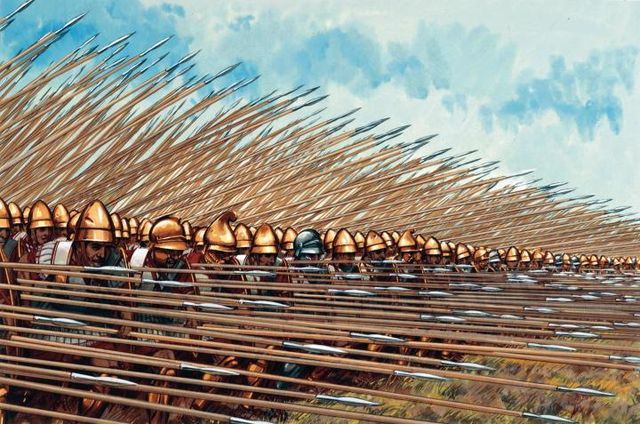
Ancient sources are somewhat mixed on what to call this new type of soldier. Arrian, the most famous biographer of Alexander "the Great" refers to these men as Pezhetairoi, or "Foot Companions." By contrast, our two other good sources for information on the Hellenistic era, Diodorus Sicilus and Polybius of Megalopolis refer to these men as "Phalangites." That is the term which we will employ in our discussion of these soldiers. These Phalangites used a pike, the σαρίσα, (Sarissa), which was possibly up to 18 feet long, much longer than the dory. While historians disagree on exactly when the Sarissa came into use, it may have been used as early as the Battle of Choronea in 338 B.C.E. The Phalangites formed the Sarrisa Phalanx (an unwieldy term but better than "Phalangite Phalanx"). Macedonian generals arrayed the Sarissa Phalanx at varying depths, with 8, 16, and 32 being some of the most common. Since the Phalangites often used a smaller shield than the Hoplite, they depended on the deep hedge of spears (perhaps 3, 4 or even 5 projecting beyond the front rank of men) in order to defend themselves from enemy attack.

An advancing Sarissa Phalanx
 The picture above shows the awe-inspiring nature of the Sarissa Phalanx- a sight which even terrified veteran Roman commanders. However, as the ancient historian Polybius notes- the Phalanx had a number of drawbacks. It mainly useful in open terrain, when the enemy was already offering to do battle. If the cohesion of the phalanx broke up, it became vulnerable to close attack by sword-wielding infantry. Phillip II, Alexander the Great, and the Successor Kingdom's of Alexander's Empire all employed these Phalangites, often with great success. Like the Hoplite Phalanx before it, the Sarissa Phalanx depended on collective action, and mutual defense.

Once again- these were not the only types of infantry in the Greek world. We will get on to the θυρεοφοροί, θώρακταί, ψίλοί, and others in time. If none of this is new information to you- don't despair. We will get into more technical debates further up in the blog. I want to begin simply by outlining a base set of knowledge, from which we can proceed to more specific ideas.

Thanks for reading,


Alex Burns